Monday 24th June 2013 by Jack Newman
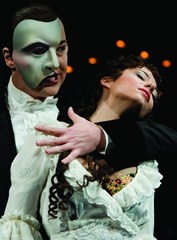 |
| The Phantom and Christine by Michael Le Poer Trench |
On the 23rd September 1909, Le Fantôme de l’Opéra appeared at the foot of page 8 in the French daily newspaper, Le Gaulois. Written in a journalistic style, the piece would go on to become the most financially successful entertainment event ever. The writer of this relatively short serial, running until 8th January the following year, was Gaston Leroux. Leroux had been a reporter for L’Echoe de Paris and Le Matin, writing noteworthy coverage of Russia’s 1905 revolution and its aftermath, as well as an intriguing piece about the death of a patron in a Parisian theatre, after a chandelier came crashing to the ground.
It is very clear that Leroux’s work was influenced and enhanced by his years as a law student and a journalist, and the sublime escalation of dread throughout Le Fantôme de l’Opéra becomes an intricate understanding of criminal psychology. However, despite posthumous critical acclaim, the newspaper series published in book form was rather a flop, seeming of little significance in comparison to Leroux’s flourishing career as trailblazer of the French detective novel, often compared to Edgar Allan Poe or Arthur Conan Doyle.
In 1925 Lon Chaney (known as “the man of 1000 faces” for his elaborate, diverse and, often, self-applied make-up) portrayed The Phantom as a Draculaesque villain in the American silent horror film titled The Phantom of the Opera. What the film lacked in realistically understanding the criminal mind, it made up for in eerie mystery and fear filled repulsion. Such was the success of this adaption and of Chaney’s Phantom, that when the story hit the silver screen again in 1943, the exact same set was used and the film remade its 1925 predecessor, rather than readapting Leroux’s book. Despite the similarities with the earlier picture, this 1943 film is a demonstration of the malleability of the Phantom story; characters are recast in different roles and backstories are rearranged and sometimes rewritten, while the loci of good and evil shift and blur slightly with each retelling of the Phantom’s tale.
A plethora of Phantom offshoots have appeared in film, television and novels throughout the 20th Century, but it is the stage that has made the story so ferociously popular and, ultimately, an international icon. Interestingly, the first musical adaption saw critically acclaimed Birmingham playwright, Ken Hill, adapt the original book and set English lyrics to classical musical scores, including Verdi and Mozart. Hill originally created the musical in 1976 with modern music, but the 1984 revival saw him turn to music that would fit the setting of 19th century Parisian opera.
The exact link between Ken Hill’s creative adaption and Andrew Lloyd Webber’s blockbuster is mysterious but it certainly involves the singer and actor Sarah Brightman, who was married to Webber at the time. When Hill approached her to play the role of Christine, she turned it down, perhaps waiting for a better opportunity. Not long after, Andrew Lloyd Weber and Cameron Mackintosh attended a performance of Hill’s musical and, amid much excitement, discussed with Hill the possibility of taking it to the West End on a grand scale. The conversations between them are unknown and rarely mentioned by either party but we do know that they came to a halt, and two years later Sarah Brightman starred as Christine in Weber and Mackintosh’s West End show, The Phantom of the Opera. Ken Hill, uninvolved in the West End version, continued with his own production, commenting “it happens in show biz all the time. After all, Phantom was public domain”.
It is Andrew Lloyd Weber’s Phantom that has become the world famous musical. It owes its success to Gaston Leroux, Lon Chaney and Ken Hill but there is a reason why it is this adaption that has become the king of all stage musicals, and booking a seat at Her Majesty’s Theatre is the only way to truly understand why.