Sunday 15th September 2013 by Jack Newman
Even the most complex and outrageous characters can be brought to life by an accomplished actor, treading the boards with skill and sentiment. While makeup and costumes are essential in many roles, the intelligence and willingness of the actor is the essence of a successful onstage performance. Therefore, when writing a part for a good actor, creativity is free to flow.
A common problem arising in theatre is what to do when a character is not human. Animals in a script create a practical hurdle that must be overcome either by the writer(s) themselves or by the unfortunate person who is tasked with bringing the script to life. There are four common solutions to this sticky problem:
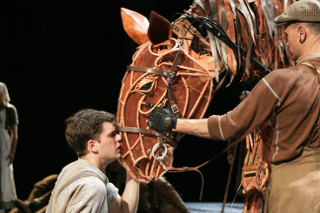 |
| A puppet horse from War Horse |
1) Puppetry
At the moment two shows vie for the position of the puppet king in the West End. The Lion King brings together an incredible cornucopia of animals, staging a breath-taking spectacle of costume design (see below) and puppetry. Timone, Pumba’s meercat friend, is held by a puppeteer dressed neatly as the local vegetation, and is animated so delightfully that you almost forget he is being operated by a dubious looking cactus. However, the sheer grace of a horse galloping across the stage in the New London Theatre gives War Horse the edge in this department. Created by the now-famous Handspring Puppet Company, the ingenious designs breathe life into the wooden frames, effectively creating animals that can follow a script.
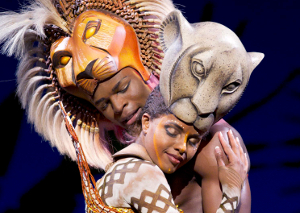 |
| Simba and Nala from The Lion King |
2) Costume design
The Lion King blurs the line between puppetry and costume design, utilising the combination with great effect. Some of the most beautiful animals onstage are the giraffes, who stroll majestically across the Serengeti plains, leaving audiences effectively unaware that they are sat in London’s Lyceum Theatre. Against this backdrop the main characters, Simba and Nala, look a lot more like humans than they do lions. Their costumes allow the script and songs to flow freely without ever losing the feeling of being within the animal kingdom.
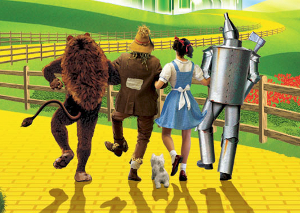 |
| A real dog usually plays Toto |
3) Real animals
This is a risky proposal, and for some it is simply not an option. Housing giraffes in the admittedly cavernous Lyceum Theatre would be quite a challenge! A recent example of a real animal being a stage hit is Toto, Dorothy’s terrier in The Wizard of Oz (whose sister show Wicked remains largely animal-free). While the show also uses costume design for the cowardly lion, who is required to convey much more as a character, it is Toto who captures audience attention, as people are stunned just how well a dog can be trained to act. It will, however, never be taught a script, which is the problem faced by pig-based-musical Betty Blue Eyes…
4) Robotics
The makers of the bizarre but brilliant Betty Blue Eyes required the leading pig to talk and sing. A person dressed sheepishly as a pig did not really cut the mustard for the bold producers of this quirky show so they pursued other possible solutions. While puppetry may have worked, a robotic pig was the light bulb idea that saw Betty Blue Eyes adored by audiences. Unbelievably, Kylie Minogue was the voice of this fantastic work of engineering. While there are very few robotic animals in the West End, it could be something for the future as technology allows more flexible solutions to the age old problem of putting animals on the stage.