Thursday 17th July 2014 by Will Langdale
The Curious Incident of the Dog in the Night-Time
Now on its third West End theatre, The Curious Incident of the Dog in the Night-Time has already won a great deal of praise both for its run at the National Theatre, and its ill-fated run at the Apollo. Adapted from the hit novel by Mark Haddon and with a slew of awards to its name already, this newest incarnation of the play has some very big boots to fill. Having moved across the road to the Gielgud Theatre, can the new Curious Incident live up to the rave reviews it received in its previous homes?
We think it very much can. Christopher is a 15-year-old maths savant with Asperger’s syndrome, and the discovery of a neighbour’s murdered dog leads him on a treacherous journey of growth and discovery. As the emotional lynchpin of the story, Christopher is a vital and demanding role, played with panache by Graham Butler, who largely steps out of the shadow of Luke Treadaway’s award-winning turn in the role. It’s not until the second act that you begin to appreciate the athleticism the role demands, and just how important Butler’s performance is to your enjoyment, but Butler winds a careful urgency into the portrayal that keeps it pleasantly clear of indulgence or melodrama. If Curious Incident must trust its fortunes to a strong leading actor, Butler is more than equal to the task.
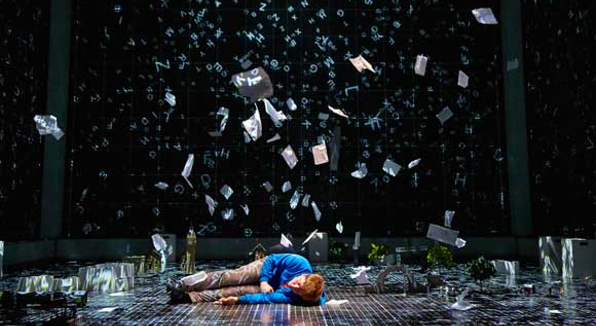
Where Curious Incident excels is its ability to render the world in a way that is as alien and confusing to the audience, just as the real world presumably is to Christopher. The play is staged on the inside of a projected cube of graph paper, and vary rarely utilises visually appropriate props unless they are of particular significance to Christopher, such as a train set or a sleeping bag. There is a malleability to the physical spaces that events occur in, such as what’s up or down or inside or out, as well as the relationship between the time that’s being portrayed and the time that is “actually” passing. This plasticity is a bold evocation of the world of a boy whose frame of reference is more physics than physical, and is fascinating to see unfold.
Part of the play’s framing is that Christopher is its author, and his work is being acted out: The Curious Incident of the Dog in the Night-Time is a book he writes about solving the mystery of the dog’s death, the title a reference to his love of Sherlock Holmes stories. While this is an interesting concept, it does mean that some of the humour can sit a little awkwardly, such as a brief allusion to Christopher’s father’s possible drinking problem, or a recurring character whose one-liners seems extraneous. While something heart-meltingly cute happens towards the end of the play – and you can guarantee your eyes will become wide and gooey, and a small, girlish squeal may begin to emit from the back of your throat – there are one or two points where you can feel a little bit like you’ve been goaded into a cheap reaction.
It’s a minor complaint in an otherwise sterling production. Christopher’s relatives are a delight whether they’re trying to care for him and aren’t sure how, or whether they’re bickering or arguing or trying to explain to a child who doesn’t lie why they’re not perfect people. Emily Joyce and Nicolas Tennant in particular deserve high praise. Whether you’ve seen the previous productions or are completely new to the play, The Curious Incident of the Dog in the Night-Time is an excellent night out, and a great example of how the tools of the theatre can be used to approach a very difficult subject with verve.
Fancy booking a West End theatre break to see The Curious Incident of the Dog in the Night-time? We can help! Packages are from just £64pp.